Samsung Odyssey G7 review: 240Hz curved QHD for esports

The Samsung Odyssey G7 pairs a blistering 240Hz refresh with QHD sharpness and the deep blacks of a VA panel, all on an immersive curved 32-inch screen. It is built for speed, and for fast competitive games it feels superb, here is who should buy it.

Transparency: This article contains affiliate links. If you buy through one of them, we may earn a commission, at no extra cost to you. That is how we fund our testing and keep this site independent. More about how we test.

Contents

The Odyssey G7 made a statement when it arrived: a 240Hz refresh rate at QHD resolution, on a large curved VA panel that combined esports-grade speed with contrast that IPS rivals simply cannot match. It is an unapologetically gaming-first monitor, the aggressive curve and the focus on raw responsiveness make that plain. If your priority is fast, fluid competitive play and you have the graphics card to feed it, the G7 is one of the most exciting screens you can buy.

Specifications

Model Price ResolutionRefresh ratePanel / size Rating Link
Samsung Odyssey G7 32" QHD 240Hz Curved (LC32G75T) ★ Top pick Samsung Odyssey G7 32" QHD 240Hz Curved (LC32G75T) £340.67 2560 x 1440 (QHD)240 HzVA (1000R curve), 32" ★ 4.3 View →
★ Top pick
Samsung Odyssey G7 32" QHD 240Hz Curved (LC32G75T) £340.67
Resolution : 2560 x 1440 (QHD)Refresh rate : 240 HzPanel / size : VA (1000R curve), 32" ★ 4.3/5
View on Amazon →

Our in-depth review

BEST HIGH REFRESH
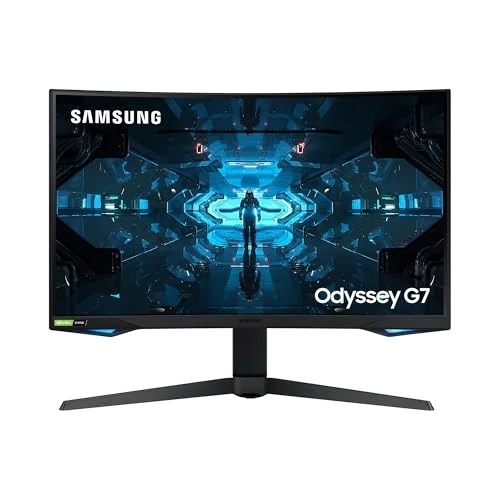
Samsung Odyssey G7 32" QHD 240Hz Curved (LC32G75T) - gaming monitor Samsung

Samsung Odyssey G7 32" QHD 240Hz Curved (LC32G75T)

4.3/5

£340.67

2560 x 1440 (QHD) · 240 Hz · VA (1000R curve), 32"

  • Blistering 240Hz refresh for competitive play
  • Deep VA contrast with strong dark scenes
  • Aggressive 1000R curve wraps the action around you
  • QHD sharpness on a large 32" panel
  • The 1000R curve divides opinion and is poor for creative work
  • Needs a strong GPU to push 240fps at QHD
Image quality 4/5
Response 5/5
Value 4/5
View on Amazon →

The verdict from Adam Khan, display and gaming hardware tester

The pick for high-refresh competitive gaming. The Samsung Odyssey G7 pairs a 240Hz refresh with QHD sharpness and the deep blacks of a VA panel, all on an immersive curved 32" screen. It demands a powerful graphics card to feed it, and the steep curve is a love-it-or-hate-it choice, but for fast esports titles where every frame counts, few monitors feel this responsive.

Eye-wateringly smooth in fast shooters, with inky blacks that IPS rivals cannot match.

Who is the Samsung Odyssey G7 for?

The G7 is the right monitor if competitive, fast-paced gaming is your priority and you own a high-end graphics card. The 240Hz refresh is its reason to exist, and in fast shooters and esports titles the difference over a 144Hz panel is real, motion is glassy-smooth and inputs feel instant. The QHD resolution keeps the image sharp on the large 32-inch panel, and the VA technology brings deep contrast that makes both bright and dark scenes pop.

It is less suited to two kinds of buyer. If you have a mid-range GPU, you will struggle to reach anywhere near 240fps at QHD in modern games, so much of the panel's speed goes unused, the LG UltraGear 27GP850 makes far more sense. And if you do any creative or office work, the steep curve is a genuine drawback, because it distorts straight lines and is poor for design tasks.

How the Samsung Odyssey G7 performs

Speed and motion

This is the G7's headline strength. The 240Hz refresh paired with a fast 1 ms VA response makes fast competitive games feel extraordinarily fluid and responsive. If you are coming from 144Hz, the extra smoothness is noticeable in quick flicks and fast tracking, and it is exactly what serious esports players are paying for. You do, however, need the hardware to back it up, which we will come back to.

Contrast and image

Where IPS panels look slightly washed out in the dark, the G7's VA panel delivers deep, convincing blacks and strong contrast. That makes dark, atmospheric scenes far more immersive and gives the whole image more punch. Combined with QHD sharpness on a big 32-inch screen, it is a genuinely cinematic look for single-player games as well as a fast one for competitive play.

The 1000R curve

The G7 uses an aggressive 1000R curve, one of the steepest on the market. In games it can feel immersive and wrapping, drawing the edges of the screen into your peripheral vision. But it is a love-it-or-hate-it design: some players find it natural, others find it distracting, and for any work involving straight lines it is plainly unsuitable. This is the single biggest thing to be sure about before you buy.

Build and features

The build is solid and gamer-styled, with an adjustable stand and a sensible set of inputs including DisplayPort for the full 240Hz. The on-screen menu and gaming features are comprehensive, as you would expect from a flagship Samsung panel.

The honest downsides

Two things give pause. The first is the curve, as above, it is aggressive enough that you should be confident you want it, and it rules the monitor out for creative work. The second is the hardware requirement: 240Hz at QHD is a lot of frames, and only a powerful, modern GPU will get close in demanding games. Buy the G7 to pair with a strong card and a love of fast games, and it delivers, buy it for a mid-range build and much of what you paid for sits idle.
Frequently asked questions

Q
Is the Samsung Odyssey G7 curve too aggressive?

The G7 uses a steep 1000R curve, which is more aggressive than most monitors. In games it can feel immersive and wrapping, but it is a love-it-or-hate-it choice and it is poor for photo, video or design work where straight lines matter. If you are unsure about a strong curve, a flatter panel such as the LG UltraGear 27GP850 is the safer pick.

Q
Do I need a powerful PC for 240Hz at QHD?

Yes. Reaching close to 240fps at 1440p in modern games needs a high-end graphics card; mid-range hardware will sit well below that in demanding titles. In fast esports games the frame rate is much easier to hit, which is exactly where the G7's 240Hz refresh pays off most.

Q
Is the Odyssey G7 good for single-player games?

Very. The VA panel's deep contrast and rich blacks make atmospheric, story-driven games look excellent, and the large 32-inch curved screen is immersive. The only caveat is that VA panels can show a little dark smearing in the very fastest scenes, though on the G7 it is well controlled.

Verdict on the Samsung Odyssey G7

The Odyssey G7 is our pick for high-refresh competitive gaming because few monitors feel this fast, and the deep VA contrast is a real bonus over IPS rivals. For a player with a high-end GPU who lives in fast shooters and esports, it is a thrilling, immersive screen. Just be sure about two things first: that you want the steep 1000R curve, and that your graphics card can actually push enough frames to use the 240Hz. If either is in doubt, the all-round LG UltraGear 27GP850 is the safer choice, and if you want the very best image of all, see the ASUS ROG Swift OLED. To understand the panel trade-offs in full, read our IPS vs VA vs OLED guide.